
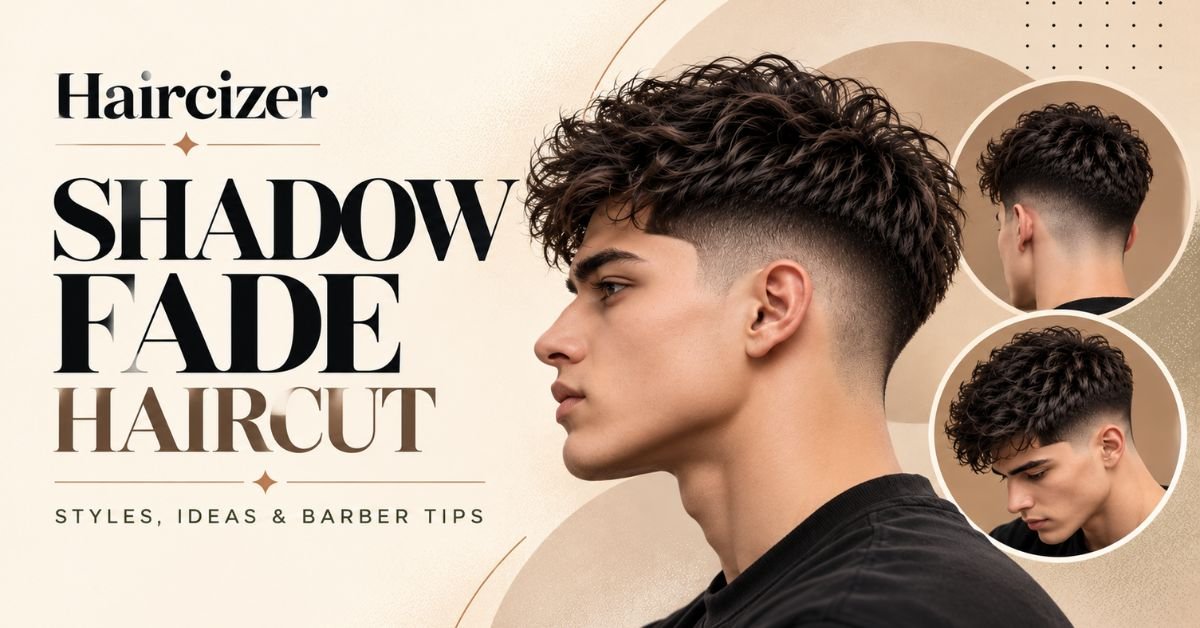
A shadow fade haircut is a clipper cut where the sides and back blend from longer hair into a faint “shadow” of stubble, instead of going all the way down to bare skin. It looks sharp, clean and a little softer than a skin fade. That is why so many people now ask for it by name.
This guide explains what a shadow fade is, how it differs from a skin fade and a taper, and how low, mid and high placements change your look. You will also get a simple script for your barber, the clipper guards involved, and a maintenance routine that keeps the cut fresh.
What is a shadow fade haircut?
A shadow fade is a gradual blend from the hair on top down to very short stubble at the base. The shortest point stays at roughly a #0.5 or #1 guard length, so you always see a light dusting of hair, never smooth skin.
Quick answer: A shadow fade is a fade that stops at short stubble (about 1.5 mm to 3 mm) rather than bare skin. It gives a soft, smoky gradient with low contrast.
Think of it as the gentle cousin of the skin fade. You still get clean sides and a modern shape. You just skip the sharp, high-contrast look of shaved skin.
Why is it called a shadow fade?
The name comes from how the cut looks. At the bottom of the fade, the hair is so short that it reads as a soft, dark shade on the scalp, like a shadow. There is no bright skin line to break the blend.
Barbers also use the word “shadow” for the tone of the lowest section. The scalp seems tinted by hair growing underneath. On darker hair this shade looks deeper. On lighter hair it looks more subtle.
Where does the shortest hair stop?
The shortest hair stops at a short stubble, not at the skin. In most shops that means:
- #0.5 guard: about 1/16 inch, or 1.5 mm
- #1 guard: about 1/8 inch, or 3 mm
Some barbers also use a closed-lever clipper with no guard for a slightly tighter shadow. The key point is that the base keeps visible hair. If your barber reaches skin, that is a skin fade, not a shadow fade.
What clipper guard makes a shadow fade?
Most barbers use a mix of guards, not just one. A common path looks like this:
- Remove bulk with a #3 or #4 guard.
- Set the fade line with a #2 guard.
- Work down with a #1.5 and #1 guard.
- Finish the base with a #0.5 guard or a closed-lever clipper.
The exact numbers shift with hair thickness and the look you want. Treat this as a general map, not a strict rule.
Does a shadow fade require a #0.5 or #1 guard?
Not strictly. Either one works, and your pick changes the mood of the cut.
| Base guard | Length | Look | Best for |
| #0.5 | 1.5 mm | Very close, darker shade | A sharper shadow with more contrast |
| #1 | 3 mm | Slightly fuller, softer shade | A gentle, natural blend |
If you want the most subtle result, ask for a #1 base. If you want something closer to a skin fade without the bare scalp, ask for a #0.5 base.
Shadow fade vs skin fade vs taper fade: what’s different?
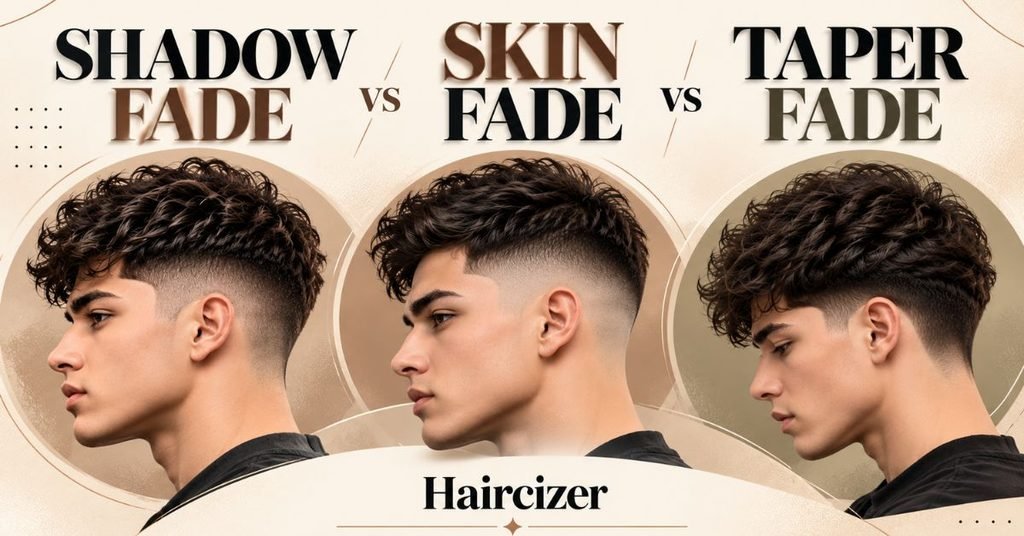
These three cuts are often mixed up, even by regular clients. The difference comes down to two things: how short the base goes and what happens at the natural hairline.
| Feature | Shadow fade | Skin fade | Taper fade |
| Shortest length | #0.5 to #1 stubble | Bare skin | Short but clearly visible hair |
| Contrast | Soft | High | Low |
| Hairline | Often fades away | Fades away | Natural hairline stays |
| Finish | Smoky, subtle | Crisp, clean | Neat, classic |
| Touch-up time | About 2 to 3 weeks | About 1 to 2 weeks | About 3 to 4 weeks |
The skin fade is the boldest of the three. The shadow fade sits in the middle. The taper is the most conservative, since it mainly tidies the neckline and the area around the ears and leaves the rest of the length natural.
Is a shadow fade the same as a taper fade?
No. A taper fade follows your natural hairline and only trims short around the sideburns and neck. A shadow fade works across a larger part of the sides and back, and it blends down to stubble.
You can combine them. Some people get a shadow fade on the sides and a tapered neckline for a softer finish at the back.
Who should choose a shadow fade, and who should skip it?
A shadow fade suits most people, but it is not perfect for everyone. Here is a quick guide.
A shadow fade is a good pick if you:
- Want a clean look without a harsh skin lineccc
- Work in an office or a place with a neat dress code
- Have a sensitive scalp that dislikes foil shavers or razors
- Like a cut that still looks tidy as it grows out
- Want a fade that works with a beard
You may want to skip it if you:
- Love ultra-sharp, high-contrast edges
- Have patchy growth or scars on the sides that you would like to hide
- Hate frequent barber visits, since fades do show growth fast
- Prefer very long hair all over
When is another fade a better choice?
Sometimes a different cut simply fits better.
- Skin fade: Choose it when you want maximum contrast, especially with dark, thick hair on top.
- Taper fade: Choose it when you need a neat look with minimal upkeep, or when you want to keep length at the sides.
- Drop fade: Choose it when you want the line to curve behind the ear for a more modern shape.
- Burst fade: Choose it when you want a round, bold fade around the ear with a mullet or longer back.
If you are unsure, bring a photo and ask your barber what suits your head shape and hair growth pattern. They see your crown, cowlicks and density up close, which a photo cannot show.
Low vs mid vs high shadow fades: which placement should you choose?
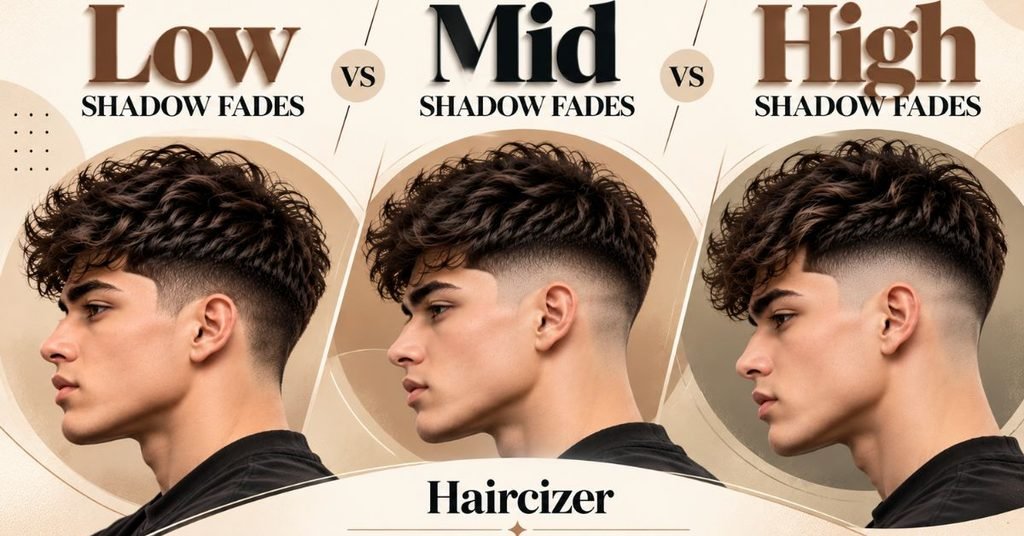
Placement means where the fade begins on the head. The same shadow finish looks very different when it starts low or high.
| Placement | Where it starts | Contrast | Maintenance | Best for |
| Low | Just above the ears and nape | Subtle | Lower | Work, school, first-timers |
| Mid | Around the temples | Balanced | Medium | Most hair types and face shapes |
| High | Near the crown or upper temples | Bold | Higher | Statement looks, sporty styles |
Low shadow fade
A low shadow fade starts just above the ear and curves down toward the nape. It leaves most of the side hair intact, so the result looks neat and calm.
This is the safest choice if you have never had a fade before. It also grows out gracefully, because the fade zone is small. Many people pair it with a side part, a textured crop or a classic cut.
Good for: office settings, longer tops, beards and anyone who wants a subtle finish.
Mid shadow fade
A mid shadow fade begins around the temple line, about halfway up the side of the head. It balances short sides with a good amount of top length.
This is the most flexible option. It looks good on oval, square and round faces, and it works with quiffs, French crops and slick-backs. If you cannot decide between low and high, mid is a safe bet.
Good for: everyday wear, mixed hair textures and people who want a modern look without drama.
High shadow fade
A high shadow fade starts high, near the upper temples or crown. It exposes more of the side and back, which creates a strong contrast with the top.
This style looks bold and athletic. It can make the top of your hair appear taller and fuller. It also shows growth faster, so plan for more frequent touch-ups.
Good for: pompadours, high tops, curly tops and people who want a statement cut.
Can the placement follow a curve instead of a straight line?
Yes. The fade line does not have to run level around the head. Barbers often shape it to flatter your skull and hair growth.
- Straight line: The fade stays level all the way around. It looks crisp and balanced.
- Drop curve: The line dips behind the ear and sits lower at the back. It follows the natural shape of the head.
- Rounded curve: The line arcs gently around the temple and ear. It softens the look for longer hair on top.
A curved placement can hide an uneven head shape or a prominent crown. Tell your barber if you want the line to follow your head, not run straight.
Which hairstyles and hair textures suit a shadow fade?
A shadow fade pairs well with many styles. The top does most of the talking, while the fade frames it.
Shadow fade with straight or wavy hair
Straight and wavy hair respond well to a shadow fade. The soft base gives the top a neat frame without making the cut look severe.
Try these pairings:
- Textured crop: Short, messy and easy to style
- Side part: Clean and classic for work
- Quiff: Volume at the front with a sharp finish on the sides
- Slick-back: A polished look that works well with a mid fade
Straight hair shows every line, so ask your barber to blend slowly and check for dark patches. Wavy hair hides small flaws more easily.
Shadow fade with curly or coily hair
Curls and coils look excellent with a shadow fade. The contrast between tight curls on top and a soft base creates shape and definition.
A few points matter here:
- Keep the top at a length where curls can form. Too short, and the pattern disappears.
- Ask for a clear fade line so the curls sit on a neat base.
- Consider a mid or high placement to give curls room to stand out.
- Moisturize the top daily, since coily hair dries fast.
Shadow fades also work well on tightly coiled hair because the stubble base looks even and sharp. A skin fade can look harsh on some scalps, while a shadow fade feels softer.
Shadow fade with a mullet, mohawk or other bold top
Bold tops look great with a shadow fade because the base stays quiet and lets the style stand out.
- Mullet: A shadow fade on the sides keeps the shape tidy while the back stays long. A burst or drop fade can add extra style.
- Mohawk: A high shadow fade makes the strip look strong and clearly defined.
- Pompadour: A mid or high fade lifts the front and keeps the sides crisp.
- Long top with undercut feel: A high shadow fade gives you contrast without bare skin.
When the top is dramatic, a softer base prevents the whole cut from looking too extreme.
How should you ask your barber for a shadow fade?

Many bad haircuts come from simple miscommunication. The word “fade” means different things to different barbers, so be specific.
What five details must you specify?
Cover these five points and you remove most of the guesswork:
- Fade type: Say “shadow fade” and mention that you do not want skin.
- Placement: Choose low, mid or high.
- Base length: Choose a #0.5 or #1 guard for the shortest part.
- Top length: Give a clear number, such as “about 3 inches on top.”
- Neckline and edges: Choose a tapered, rounded or squared neckline, and decide whether you want a sharp line-up.
If you are unsure about any of these, ask your barber for advice. A good barber will happily explain the options.
What should you say and show your barber?
Pictures are the fastest way to share a haircut. Bring two or three photos from the front, side and back. Try to find examples on a similar hair type to yours.
You can say something like:
“I’d like a mid shadow fade, with the shortest part at a #1 guard so there is no skin showing. Please keep about three inches on top and a tapered neckline.”
Also mention how much time you spend styling. If you want a wash-and-go cut, say so. Your barber can then shape the top to match.
Finally, ask them to check the blend with you in the mirror before they finish. This takes a few seconds and prevents regrets.
How does a barber create a clean shadow fade?
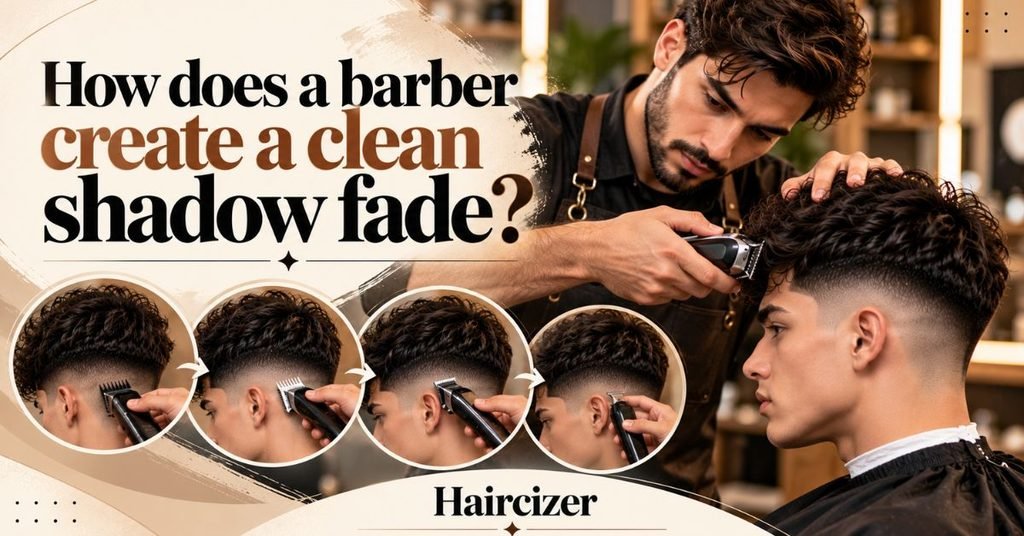
Barbers follow a clear process to build the blend. The exact steps vary, but the logic stays the same.
- Consult: The barber checks your hair growth, crown and density, then agrees on placement and length.
- Debulk: They remove weight from the sides and back with a longer guard.
- Set the base: They cut the lowest section with a #0.5 or #1 guard, or a closed-lever clipper.
- Build the gradient: They move up in small steps, using in-between guards or lever adjustments to avoid harsh lines.
- Blend the lines: They use the clipper-over-comb technique or the clipper edge to remove any visible steps.
- Connect the top: They blend the fade into the longer top hair so there is no sudden jump.
- Detail the edges: They clean the neckline, ears and sideburns with a trimmer.
- Final check: They inspect the cut from every angle and fix any patchy spots.
The slow, patient work in steps 4 and 5 is what makes the fade look smooth.
What does good shadow-fade blending look like?
You can judge a fade by a few simple signs.
- No visible lines: You should not see steps or stripes between lengths.
- Smooth gradient: The hair gets gradually lighter as it moves down, like a soft shadow.
- Even on both sides: The fade starts at the same height on the left and right.
- No bald spots or dark patches: The stubble looks consistent.
- Clean top connection: The fade flows into the top without a hard edge.
- Neat edges: The neckline and ears look tidy, with no stray hairs.
Check the cut in good light and turn your head. A strong blend looks smooth from every angle.
How long does a shadow fade last, and how do you maintain it?
Fades show growth faster than most haircuts, because the shortest areas fill in quickly. A shadow fade is a little more forgiving than a skin fade, since the base does not show bare skin turning into stubble. Still, it needs regular care.
When should you book a shadow-fade touch-up?
Most people look best with a fresh cut every two to three weeks. Here is a rough guide.
| Placement | Touch-up window | Notes |
| Low | 3 to 4 weeks | Grows out gently |
| Mid | 2 to 3 weeks | Most common schedule |
| High | 1.5 to 2.5 weeks | Shows growth faster |
Fast growers, people with thick hair and anyone who likes a crisp look should aim for the shorter end. If you wear a beard with your fade, your barber may suggest more frequent visits to keep both blended.
How should you maintain the cut between visits?
Small habits keep the cut looking fresh.
- Wash regularly: Use a gentle shampoo to keep the scalp clean and stubble soft.
- Moisturize: Dry skin makes short hair look dull and can cause flakes.
- Style the top daily: Use clay, paste or cream that suits your hair type.
- Brush or comb: This keeps the top neat and helps it blend with the sides.
- Protect your scalp: Wear sunscreen or a hat, especially on the exposed sides.
- Avoid DIY fades: A quick trim at home often creates uneven lines. If you must tidy something, use a trimmer only on the neckline and let your barber fix the rest.
- Sleep smart: A silk or satin pillowcase reduces friction on longer tops and curls.
Ask your barber which products and tools suit you. They can also tell you when a small cleanup between full cuts makes sense.
What mistakes should you avoid with a shadow fade?
Even a great barber cannot fix poor communication or poor care. Avoid these common mistakes.
- Saying only “fade”: This can end with a skin fade you did not want. Always say “shadow fade” and give a guard number.
- Forgetting placement: A high fade when you wanted a low one changes the whole look.
- Choosing a fade that clashes with your top: Very short tops with a high fade can look severe. Match the two on purpose.
- Skipping reference photos: Words can be misread. Photos remove doubt.
- Ignoring your head shape: Cowlicks, crowns and scars change how a fade sits. Ask your barber to adjust for them.
- Waiting too long between cuts: The blend vanishes and the style looks messy.
- Over-washing or under-moisturizing: Both can leave the scalp dry and visible.
- Trying to fix it at home: Small mistakes become big ones fast. Book a quick visit instead.
- Rushing the final check: Look at the sides and back before you pay. Speaking up early is easy. Fixing a bad blend later is not.
Shadow fade FAQs
What is a shadow fade haircut?
A fade that blends down to short stubble instead of bare skin.
Does a shadow fade show skin?
No, a light layer of stubble always stays at the base.
Which guard is best for a shadow fade?
A #0.5 guard for a closer look, or a #1 guard for a softer one.
Is a shadow fade the same as a skin fade?
No, a skin fade goes down to bare skin.
How often should I get a shadow fade touch-up?
Every two to three weeks keeps the blend clean.
Can curly hair get a shadow fade?
Yes, it frames curls and coils very well.
Conclusion
A shadow fade gives you the clean, modern look of a fade without the bare-skin edge. It blends down to a soft #0.5 or #1 stubble, which keeps the finish smooth and easy to wear. Choose a low, mid or high placement based on your hair, your face and your daily routine.
Good results come from clear communication and steady care. Tell your barber the fade type, placement, base guard, top length and neckline, and bring photos if you can. Book a touch-up every two to three weeks, moisturize your scalp and style the top, and your cut will look sharp from the first day to the last.
Leave a Reply