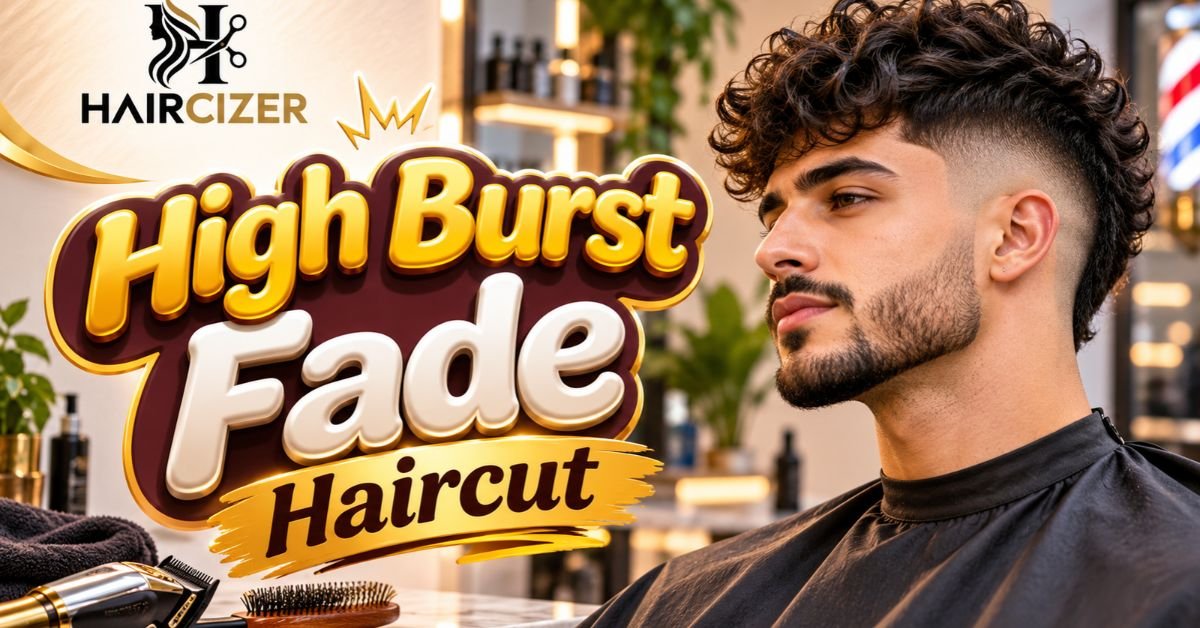
Some haircuts quietly blend in. The high burst fade does the opposite. It carves a rounded, semicircular shape around the ear, lifts the shortest zone up toward the temple, and leaves the top free to do whatever you want, from tight curls to a long, wild mullet.
If you have been scrolling through photos and wondering what makes this cut look so different from a standard fade, you are in the right place. This guide explains the cut in plain language, compares it with other popular fades, helps you decide whether it suits your hair and head shape, and gives you the exact words to use in the barber chair.
You will also find styling advice by hair texture, a realistic touch-up schedule, and honest notes on the downsides, including razor bumps and scalp care. Read it once, save your favorite looks, and walk into your next appointment with confidence.
What is a high burst fade?

A high burst fade is a fade that curves around the ear in an arc instead of running straight across the head. Think of the ear as the center of a small circle. The hair closest to the ear is cut very short, often down to the skin, and it grows gradually longer as it moves outward and upward. The back of the head usually keeps more length than the area around the ear, which gives the cut its distinctive “burst” outline.
The word “high” tells your barber where that circle starts and how far the short zone climbs. In a high version, the shortest hair sits well above the ear, close to the temple, and the blend into longer hair happens higher on the sides. The result is more skin, more contrast, and a sharper frame for whatever style you keep on top.
Barbers often describe the cut as a fade with a built-in shape. A straight fade follows a horizontal line. A burst fade follows a curve. That curve is what draws attention to the ear area and makes the cut look styled even when the top is simple.
Where the “high” placement sits
Most barbers split fades into three heights: low, mid and high. The height refers to the point where the shortest hair meets the start of the blend.
Here is a simple way to picture it:
- Low: the blend starts near the ear and the nape, close to the natural hairline.
- Mid: the blend begins around the middle of the side of the head, roughly level with the eyebrows.
- High: the blend begins near the temples or higher, leaving a large area of very short hair.
On a high burst fade, the curve around the ear starts up near the temple, so the short zone looks larger and bolder. The line then bends back down behind the ear and blends toward the nape. Because it sits so high, the cut shows off the shape of your head more than a low version does.
One practical point: “high” is not a fixed measurement. A barber will place it by eye, based on your skull shape, hairline and the length you want on top. That is why reference photos matter, and we will cover them later.
High burst fade vs low, mid, drop, taper and high fades
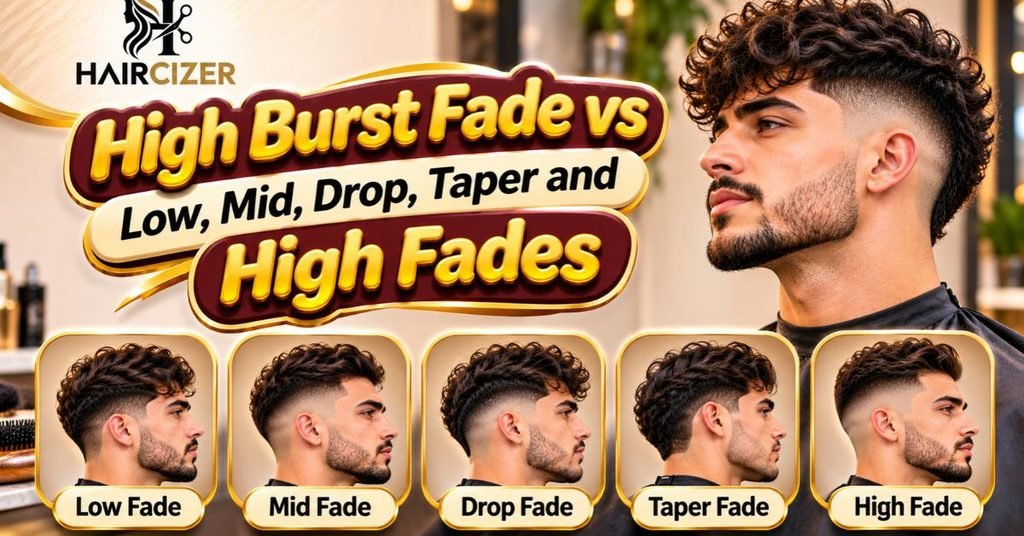
Burst fades are often confused with other cuts, mostly because the names sound similar. The table below puts the main options side by side.
| Cut | Shape of the blend | Where it starts | Contrast level | Best for |
| High burst fade | Curved arc around the ear | Near the temple or above | High | A bold look with longer hair on top |
| Mid burst fade | Curved arc around the ear | Middle of the side | Medium | A balanced, versatile cut |
| Low burst fade | Curved arc around the ear | Just above the ear | Low | A softer, office-friendly look |
| High fade | Straight line across the head | Near the temple | High | A clean, sharp, classic look |
| Drop fade | Line that dips behind the ear | Follows the ear, drops low at the back | Medium | Following the curve of the skull |
| Taper | Short, subtle gradient | Sideburns and neckline only | Low | A natural, conservative finish |
High burst vs conventional high fade
A conventional high fade runs in a fairly level band around the head. It is neat, symmetrical and easy to read. Your barber moves the clipper up the side in even passes, and the line looks straight when you view it from the front or the back.
A high burst fade breaks that pattern. The short area sits mainly around the ear, and the outline swings out and around it. The back of the head stays fuller, so the cut does not wrap all the way around as a uniform band.
Here is the practical difference. A high fade makes the whole head look cleaner and tighter. A high burst fade makes the ear area the focal point and keeps more weight at the back, which works well with mullets, long curls and anything that falls over the nape.
High burst vs drop fade and taper
The drop fade and the burst fade are close cousins, and people mix them up constantly. A drop fade follows the curve of the head and dips behind the ear, creating a line that slopes downward. A burst fade makes a rounded semicircle around the ear and leaves length at the back.
A taper is the gentlest option. It shortens the hair slightly at the sideburns and the neckline and leaves the rest of the side length mostly intact. Pick a taper if you want a subtle clean-up. Pick a burst fade if you want a visible shape.
A useful test: if you can see skin or a very short shadow above the ear from a few feet away, you are looking at a fade. If the sides still look like hair with slightly tidier edges, it is a taper.
Does a high burst fade suit you?
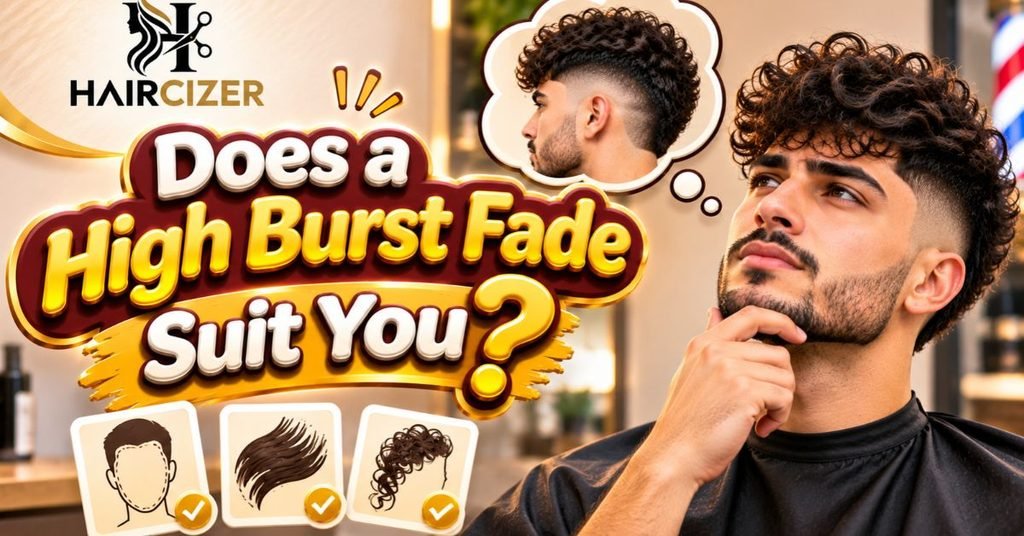
Almost any hair type can carry this cut, but the result changes with texture, density and head shape. Think about these points before you book.
Hair texture and density
Straight hair: The cut looks crisp and shows the gradient clearly. Fine, straight hair can look flat on top, so ask for texture or layers to build volume.
Wavy hair: This is one of the easiest textures to work with. The fade keeps the sides tidy while the waves add natural movement on top.
Curly and coily hair: The contrast between tight curls and a skin-short fade is striking. Dense curls hold their shape well, and the cut gives definition without much product.
Thin or receding hair: A high burst fade can work if you keep the top slightly longer and textured. A very short top can make thinning areas more obvious, so discuss this with your barber first.
Thick hair: Thick hair benefits from the fade because it removes bulk at the sides. Without it, thick hair can make the head look wider.
Head shape, hairline and crown
Head shape matters more than most people expect. A high burst fade draws attention to the temples and the area around the ears, so any asymmetry or lumps there will be more visible.
- Round faces: The high sides add vertical lines and make the face look longer. Keep some height on top to strengthen that effect.
- Oval faces: You can wear almost any version of the cut.
- Square faces: The curve softens a strong jaw, especially if you keep a slightly rounded top.
- Long or narrow faces: Go for a mid or low burst instead, or keep the top shorter to avoid adding extra height.
Look at your hairline and crown, too. A strong widow’s peak, a cowlick at the crown or an uneven hairline can all change how the fade sits. A good barber will adjust the curve to work with them. If you have a double crown, tell your barber before the first cut.
High burst fade styles to show your barber
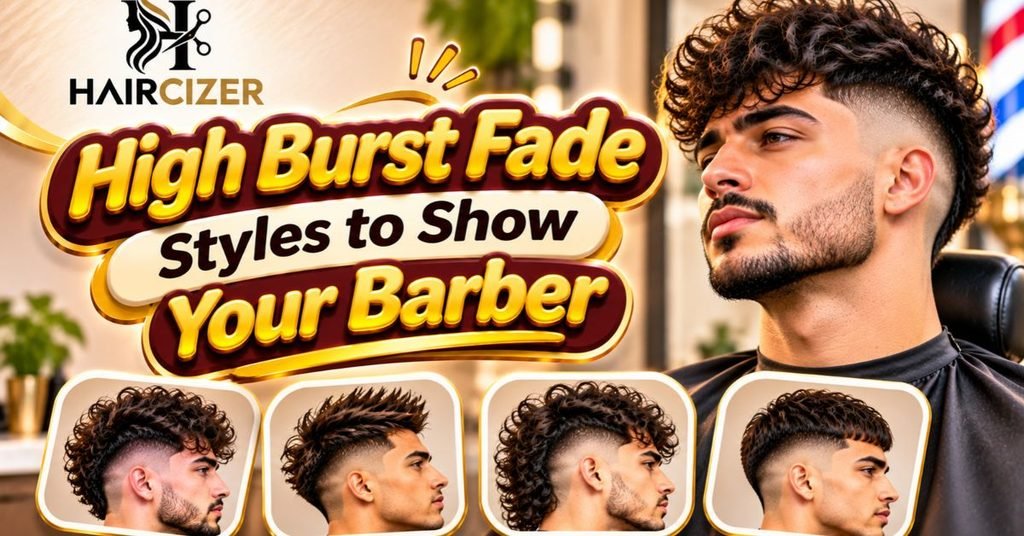
The fade is only half the haircut. What you do on top decides the personality of the look. These five styles cover the most requested options.
High burst fade with curly or coily hair
Curls and a burst fade are a natural pairing. The skin-short sides keep the shape clean, and the curls on top stay full and defined. Ask your barber to leave enough length for the curls to bounce, usually two to four inches, depending on tightness.
For coily hair, a rounded top with a sharp edge-up looks especially polished. For looser curls, try a slightly longer top that falls forward. Use a curl cream or leave-in conditioner to control frizz, and avoid brushing dry curls, because that breaks the pattern.
High burst fade mullet
The burst fade mullet, sometimes called a modern mullet, is the style that made this cut famous. The sides are faded high around the ears, the top is textured and layered, and the back is left long enough to hang over the neck.
It works because the fade removes the bulky sides that made old-school mullets look dated. The result is sharp at the front and relaxed at the back. Ask for choppy layers on top and a slightly tapered length at the nape. Straight, wavy and curly hair all work here.
High burst fade mohawk or faux hawk
A mohawk or faux hawk uses the burst fade to frame a strip of longer hair down the middle. On curly hair, the strip stands up easily. On straight hair, you will need a strong-hold product to keep it upright.
The faux hawk is the toned-down version. The sides are faded, the top is longer and brushed upward, but the strip is wider and less dramatic. It is a good choice if you want attitude without going full mohawk.
High burst fade with a textured crop or fringe
A textured crop leaves the top short, messy and forward-swept, with a fringe that sits across the forehead. It is easy to style, forgiving of fine hair, and looks modern with a high burst fade.
Ask for point cutting on the top to create the broken, choppy texture. A little matte paste or sea salt spray is enough. This is a strong option if you want a cut that looks sharp in the morning and still looks good by afternoon.
High burst fade with short hair or a buzz cut
A buzz cut with a high burst fade is the cleanest and most low-effort version. The top is clipped to one even length, and the fade creates the shape around the ear. It works well in hot weather and needs almost no styling.
Because there is no length on top to distract from the fade, the quality of the blend is on full display. Choose a barber who is comfortable with skin fades, and expect to return more often to keep the edges sharp.
How to ask your barber for a high burst fade

Many bad haircuts begin with a vague request. “A burst fade, please” leaves too much room for interpretation. A short, specific brief gets you a better result.
Five decisions to agree before the cut starts
Settle these five points with your barber before the clippers come out:
- Height of the fade: Say “high” and point to where you want the shortest hair to start, usually near the temple.
- How short at the shortest point: Choose skin (bald), a number 0.5, or a number 1 guard, depending on how much contrast you want.
- Length on top: Give a number in inches or point to a photo. “A bit off the top” is not specific enough.
- Length at the back: Decide whether you want a mullet-style back, a tapered nape or a short, neat finish.
- Edge-up and beard: Tell your barber whether you want a sharp line-up around the forehead and whether the fade should blend into a beard.
A sample request might sound like this: “High burst fade, down to skin around the ear, about three inches on top with texture, and leave the back a little long.”
The reference photos your barber needs
Photos remove guesswork. Bring two or three, and make sure they show different angles.
- A front view to show the top and the hairline.
- A side view to show the curve around the ear and the height.
- A back view to show how the cut ends at the nape.
Pick photos of people with similar hair texture to yours. A burst fade on straight hair looks different on tightly coiled hair, and your barber needs a realistic target. Be ready to explain which part of each photo you like. If you love the fade but not the top, say so clearly.
How to style and maintain a high burst fade
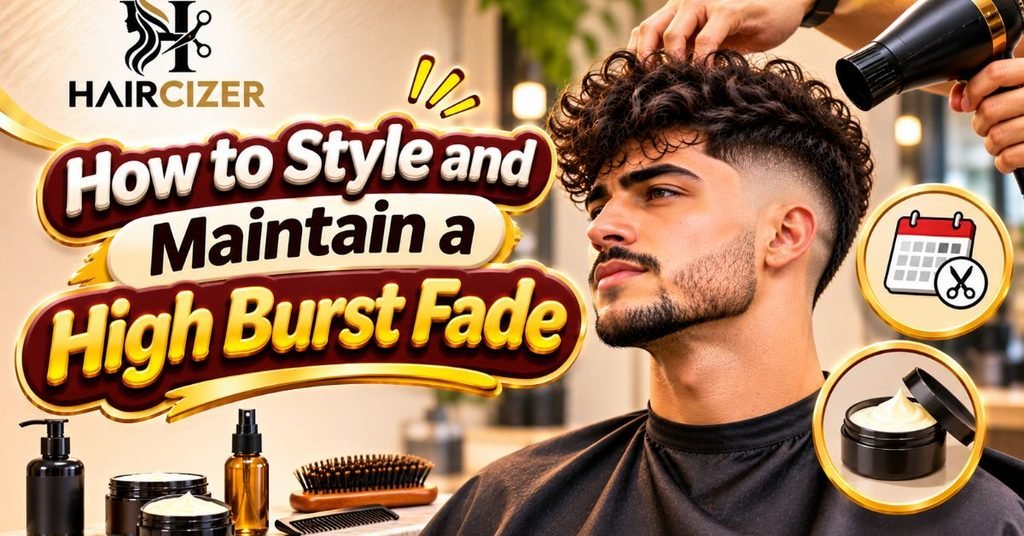
The high burst fade looks best when the top is styled with intent. The sides take care of themselves, but the top needs a little attention each morning.
Styling the top by hair texture
Also Read:Curly Low Taper Fade: Trendy Looks & Styling Secrets
| Hair texture | Best product | How to apply | Finish |
| Straight | Matte clay or paste | Rub a pea-sized amount between palms and work from the roots upward | Natural, textured |
| Wavy | Sea salt spray or light cream | Scrunch into damp hair and air dry or diffuse | Soft and defined |
| Curly | Curl cream and gel | Apply to wet hair, scrunch, and let dry fully before touching | Bouncy and defined |
| Coily | Leave-in conditioner and light oil | Smooth through damp hair, shape with fingers or a pick | Rounded and shiny |
| Fine or thin | Texture powder or volumizing mousse | Apply at the roots and blow-dry upward | Fuller and lifz |
A few general rules help across all textures:
- Start with a small amount of product. You can always add more.
- Style on slightly damp hair for better control.
- Use a blow dryer on a low setting to lift the roots, especially on fine hair.
- Brush or comb the fade area lightly so the short hair lies flat and the blend stays visible.
Touch-up timing and how the fade grows out
A high burst fade grows out faster than most cuts because the contrast is so visible. Even a few millimeters of growth softens the crisp edge.
| Weeks since cut | What you will notice | What to do |
| 1 to 2 | The fade looks sharp and clean | Enjoy it |
| 2 to 3 | The skin area starts to look shadowed | Book a quick clean-up if you want it perfect |
| 3 to 4 | The curve softens and the blend loses definition | Time for a full refresh |
| 5 to 6 | The shape is mostly gone | Expect to start the cut again |
Most people book a fresh fade every two to four weeks. If you like the skin-short look, aim for the shorter end of that range. If you prefer a softer finish, you can stretch to four or five weeks.
When the fade grows out, the hair near the ear grows longer first and the line between zones becomes blurry. It will look like a messy mid fade for a while. If you want to change styles, this is a good moment to ask for a lower version or a classic taper.
Drawbacks, common mistakes and scalp considerations
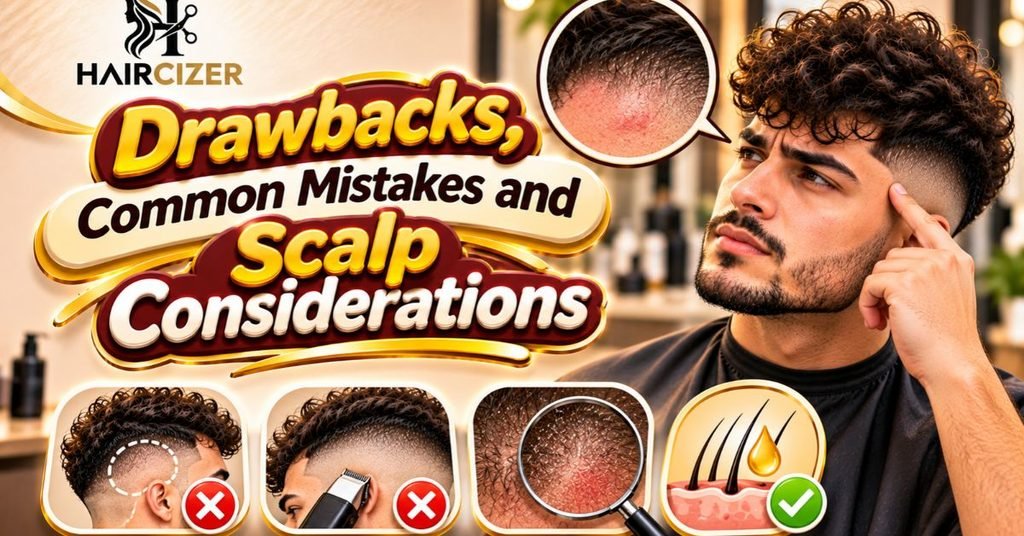
No haircut is perfect, and this one asks for commitment. Knowing the downsides helps you decide whether it fits your routine.
Common high burst fade mistakes
- Asking without a reference photo. The word “burst” means different things to different barbers.
- Going too high for your head shape. A very high fade can emphasize bumps or an uneven skull.
- Ignoring the top. A great fade with a flat, unstyled top looks unfinished.
- Skipping maintenance. The cut loses its look quickly, and waiting six weeks wastes the effort.
- Choosing the wrong barber. Blending takes skill. Check a barber’s social media for clear examples of burst fades before you book.
- Using heavy products on the sides. Pomade and wax can clump short hair and make the blend look dirty.
Close cutting, irritation and razor bumps
Cutting hair to the skin can irritate the scalp, especially in the first day or two. The area around the ears is sensitive, and a razor or a very close clipper blade can leave redness or small bumps.
Razor bumps, also called pseudofolliculitis barbae, happen when short, curly hair curls back and grows into the skin. People with tightly coiled hair are more prone to it. If you notice red, tender bumps after a skin fade, here are some sensible steps:
- Ask your barber to use a clipper or a foil shaver instead of a straight razor, or leave a hint of stubble.
- Apply a cool, damp cloth to the area after the cut.
- Use an alcohol-free aftershave balm or a gentle moisturizer.
- Avoid scratching or picking at the bumps.
- Wash your scalp with a mild shampoo and keep it clean.
Sun protection matters, too. Newly exposed skin around the ears and temples burns easily, so apply sunscreen or wear a hat on bright days. If irritation does not settle within a few days, or if you see signs of infection such as pus or spreading redness, speak with a doctor or a dermatologist. This guide offers general grooming advice and does not replace medical care.
High burst fade FAQs
What is a high burst fade?
It is a fade that curves around the ear and starts high near the temple.
Is a high burst fade the same as a high fade?
No, a high fade runs straight, while a burst fade curves around the ear.
How often should I get a high burst fade touched up?
Every two to four weeks keeps the shape sharp.
Does a high burst fade work on curly hair?
Yes, curls and a skin-short fade make a striking contrast.
What should I tell my barber?
Give the height, the length on top, the back length and a photo.
Can I get a high burst fade with a beard?
Yes, ask your barber to blend the fade into the beard line.
Is a high burst fade good for thinning hair?
It can be, if you keep the top slightly longer and textured.
How long does a high burst fade take to grow out?
The shape softens in about three to four weeks and fades fully by six.
Conclusion
The high burst fade is a bold, curved cut that frames the ear and gives any style on top a sharper outline. It works on straight, wavy, curly and coily hair, and it suits most face shapes when the barber adjusts the curve. Pick your top style first, then decide how high and how short the sides should go.
Success comes down to a clear request and a steady routine. Bring photos from the front, side and back, and agree the five key decisions before the clippers start. Book a touch-up every few weeks, protect your scalp, and your cut will stay sharp.
Leave a Reply