
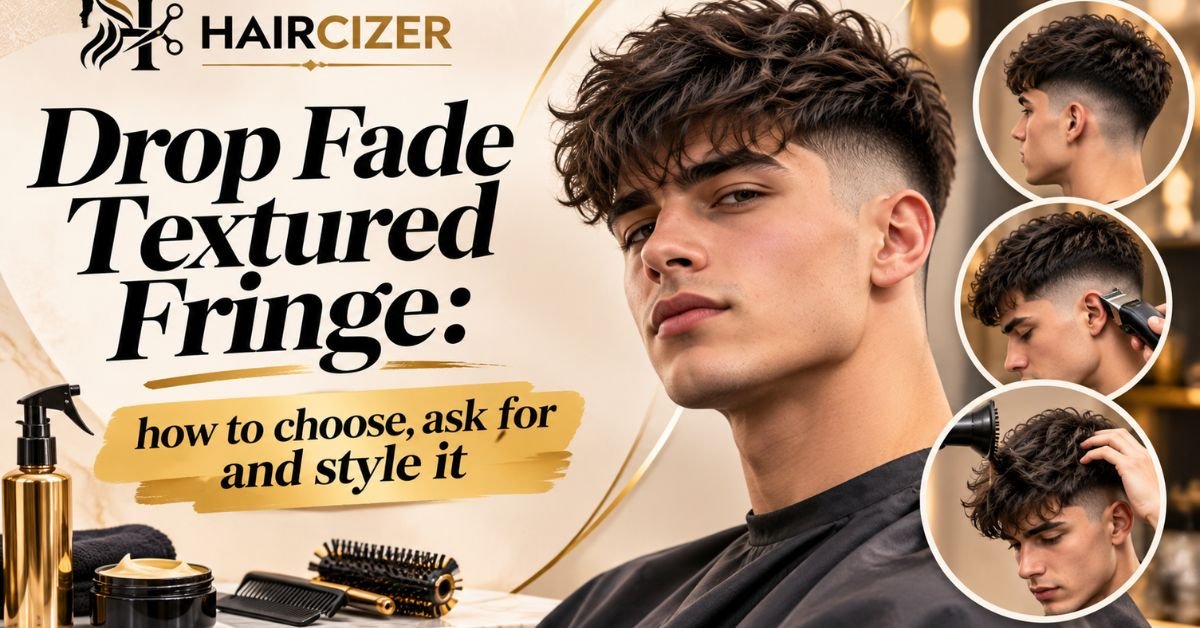
A drop fade textured fringe is one of the easiest ways to look sharp without looking stiff. The sides stay short and clean, the fade curves down behind the ear, and the front falls forward in loose, broken pieces.
The look works because it mixes two opposite moods. The fade gives you precision. The fringe gives you movement. Put them together and you get a haircut that feels polished on Monday and relaxed on Saturday.
This guide explains what the cut is, who it suits and how much length you need. You will also find a barber script, home styling steps, a trim schedule and fixes for the most common problems. If you want to walk into the shop knowing exactly what to say, you are in the right place.
What is a drop fade textured fringe?
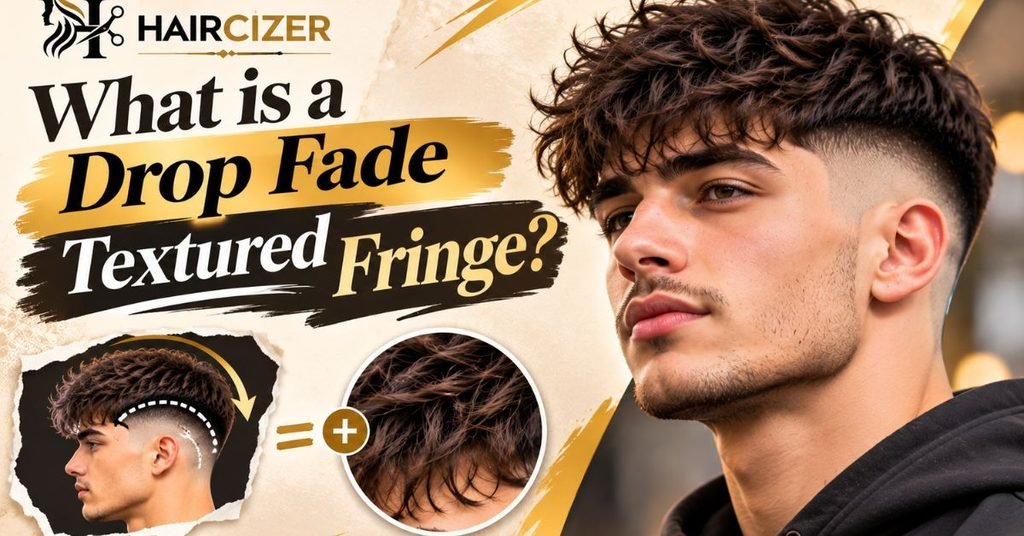
A drop fade textured fringe is a men’s haircut with a fade that “drops” behind the ear and a longer top that is cut with texture and styled forward. The sides and back are blended from short to long. The top is left long enough to form a fringe, also called a short bang, across the forehead.
Think of it as two separate jobs done by one barber:
- The fade controls the sides, the back and the outline.
- The fringe controls the top, the front and the overall mood.
Each job can be changed without ruining the other. That is why barbers like this cut and why clients keep asking for it.
What makes the fade a “drop”?
The “drop” is about the shape of the fade line. A standard fade runs in a fairly level circle around the head. A drop fade curves down behind the ear and follows the natural bone shape of the skull, so the line sits lower at the back than it does at the temple.
That small arc does three useful things:
- It frames the ear and softens the profile.
- It makes the back of the head look rounder and more balanced.
- It adds a bit of height contrast, so the top looks fuller by comparison.
Many barbers describe the drop as a “smile” shape. If you look at the cut from the side, the fade line should look like a gentle curve, not a straight shelf.
What makes the fringe “textured”?
A textured fringe is cut with broken ends instead of one blunt line. Barbers create this with point cutting, slide cutting, channel cutting or thinning shears. The idea is to remove weight in some places and leave length in others, so the hair separates into small pieces.
The result is a fringe that looks lived-in. It can be swept, pushed up, parted or left messy, and a stray piece is part of the charm rather than a flaw.
A blunt fringe, by comparison, hangs as one flat panel. It can look strong on very straight hair, but it shows every cowlick and uneven edge. Texture hides those problems.
Who does a drop fade textured fringe suit?

Most men can wear it, but the cut works best when it is adjusted to your hair and your head. Three things matter most: how your hair grows, how thick it is and how your face and skull are shaped.
Hair type, density and growth direction
Straight hair holds a clean fringe shape well, but it can look flat. Barbers usually add more texture and a little product for lift.
Wavy hair is the easiest to work with. It already has natural movement, so the fringe breaks up on its own.
Curly and coily hair gives a rounder, fuller fringe. Texture is built in, so the barber focuses on shape and length rather than heavy thinning.
Here is a quick guide:
| Hair type | What works well | What to watch |
| Straight, fine | Point cutting, light styling powder | Fringe can fall flat or look thin |
| Straight, thick | Thinning on the inside, more length at the front | Can look bulky or helmet-like |
| Wavy | Light texturizing, sea salt spray | Few issues; easy to style |
| Curly | Longer fringe, curl cream, diffuse dry | Avoid over-thinning, which causes frizz |
| Coily | Shape-focused cut, moisture, defined twists or a rounded top | Cut hair when it is stretched and dry for accuracy |
Growth direction matters too. A cowlick at the front hairline can push the fringe up or sideways. A good barber will notice it before cutting and design the fringe around it, rather than fighting it.
Density is the other piece. Thin hair needs more length and less texturizing so the fringe does not look sparse. Very thick hair needs weight removal so it does not puff out.
Face shape, head shape and hairline
The drop fade is flattering because it works on the shape of the skull. Still, a few simple rules help:
- Oval faces suit nearly every version of the cut.
- Round faces look better with more height on top and a slightly side-swept fringe, which adds length to the face.
- Square faces can handle a straight-across fringe, and texture softens the jaw.
- Long or oblong faces do best with a fuller, slightly longer fringe that shortens the forehead.
- Heart-shaped faces suit a lighter fringe and a low drop to balance the chin.
Head shape matters just as much. A flat back of the head can look better with a drop fade because the curve adds roundness. A very round head may prefer a lower drop so the sides do not look too tight.
A high hairline works well with a fuller fringe, since it covers more of the forehead. A low hairline needs a shorter or side-swept fringe so the hair does not sit on the eyebrows. A receding hairline can use a messy, forward fringe to soften the temples, though a slightly longer top is smarter than a very short one.
How much hair length do you need for a textured fringe?
You need enough length on top to fall forward and still be cut with texture. A rough working range is three to five inches (about 8 to 12 cm) on the longest part at the front.
Shorter than that, and the fringe will stand up instead of falling forward. It can still look good, but it becomes more of a textured crop than a true fringe.
Use this as a simple guide:
| Length on top | What you get |
| 2 to 3 inches (5 to 8 cm) | Short textured fringe, often pushed up or slightly forward |
| 3 to 4 inches (8 to 10 cm) | Classic textured fringe that sits on the forehead |
| 4 to 5 inches (10 to 12 cm) | Longer, more dramatic fringe that can be swept to the side |
Curly and coily hair shrinks as it dries, so those hair types often need extra length to get the same visual result. If your hair is very curly, add an inch to the numbers above, or ask your barber to cut it dry so they can see the real length.
If you are growing your hair out for this cut, tell your barber at the start. They can fade the sides while leaving the top alone and keep the shape neat during the awkward phase.
Low vs mid vs high drop fade textured fringe

The drop fade comes in three heights. The height is decided by where the fade begins on the sides, and it changes how bold the haircut looks.
Low drop fade textured fringe
A low drop fade starts just above the ear and drops behind it. It is the most conservative option, and it is the easiest to wear in an office or a school.
The fade leaves more length on the sides, so the haircut looks softer and grows out more gently. It also hides less of the head, which is helpful if you want a subtle change.
Choose a low drop if you want a tidy cut that still looks natural after four weeks.
Mid and high drop fade textured fringe
A mid drop fade starts around the temple. It balances sharpness and softness and is the most popular middle ground. A high drop fade starts higher on the head, close to the top of the parietal ridge, and creates the strongest contrast with the fringe.
The high version shows more skin, so it looks bolder and sharper. It also needs more upkeep because the contrast fades faster.
| Fade height | Start point | Look | Upkeep |
| Low | Just above the ear | Subtle, neat, professional | Every 3 to 4 weeks |
| Mid | Around the temple | Balanced, modern | Every 2 to 3 weeks |
| High | Near the top of the sides | Bold, high contrast | Every 2 weeks |
If you are unsure, start with a mid drop. Most barbers can go higher or lower on your next visit.
Skin vs shadow or guarded finish
The bottom of the fade can end in three ways:
- Skin fade (bald fade): goes down to bare skin with a foil shaver or a zero guard. It is the sharpest and shows the clearest contrast.
- Shadow fade: stops at a very short length, such as a zero-gap or a number 0.5 guard. It looks soft, like a faint shadow on the skin.
- Guarded finish: keeps a short length, for example a number 1 or 2 guard. It is the most forgiving and the lowest maintenance.
A skin fade looks great but grows out in about a week. A shadow or guarded finish is better for anyone who does not want to visit the barber every ten days. Sensitive skin may also prefer a guarded finish because it avoids razor irritation.
Drop fade textured fringe vs similar haircuts
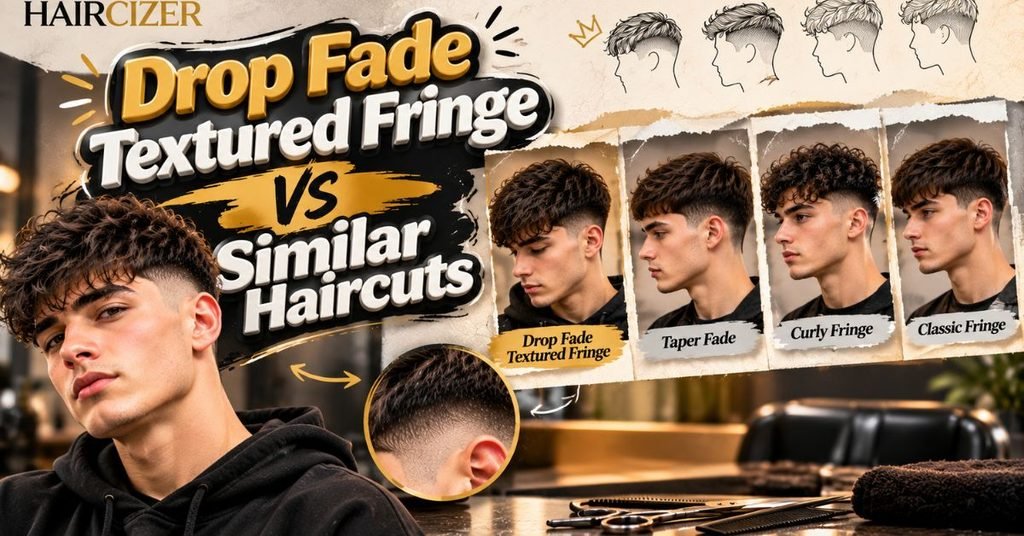
Several haircuts look alike, and the names get mixed up. Knowing the difference helps you ask for the right one.
Drop fade vs low taper textured fringe
A low taper keeps the hair longer around the ears and neckline. It is subtle and short on the nape only. A drop fade, on the other hand, is a true fade that goes shorter and curves behind the ear.
If you want a very quiet, conservative look, the taper is the safer choice. If you want a clearer fade that frames the head, go for the drop.
Drop fade vs burst fade, French crop and Edgar
These three are the cuts most often confused with it.
| Haircut | Key feature | How it differs |
| Drop fade textured fringe | Fade curves down behind the ear; longer, textured top | Rounded line at the back, soft fringe |
| Burst fade | Fade arcs in a semicircle around the ear, leaving length at the back | Often paired with a mohawk or longer back; more dramatic around the ear |
| French crop | Short, blunt, textured fringe cut straight across | Shorter top and a straighter fringe line |
| Edgar | Very blunt, straight-across fringe with sharp lines | Cleaner, stricter, with a harder fringe edge |
The burst fade is rounder and more theatrical around the ear, while the drop follows the skull and reads as cleaner. The French crop is shorter on top and has a defined fringe. The Edgar uses a much blunter cut and a stricter outline.
How to ask your barber for a drop fade textured fringe
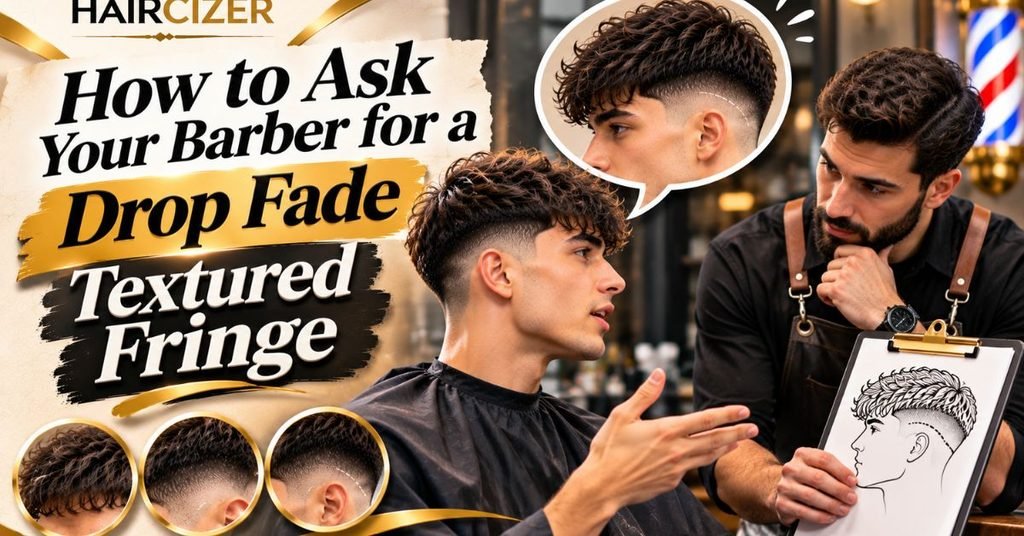
Barbers can do a great job if you give them clear instructions. Vague requests such as “a fade with some length” leave too much open to guessing.
The six decisions to specify
Before you sit down, decide on these six points:
- Fade type: say “drop fade” so the barber knows the line should curve behind the ear.
- Fade height: low, mid or high.
- Finish at the bottom: skin, shadow or a guard number.
- Top length: how long the fringe should be at the front, and whether you want it to touch the eyebrows or sit above them.
- Texture level: light, medium or heavy, plus whether you want the ends choppy or soft.
- Neckline: tapered, rounded or squared, and whether you want the beard blended in if you have one.
A sample request might sound like this: “Can I get a mid drop fade with a shadow finish, and about four inches on top? I want a textured fringe that falls forward, with a tapered neckline.”
If you aren’t sure about any of these, ask for the barber’s opinion. A good barber will explain why they suggest a higher or lower fade for your head shape.
What reference photos should you bring?
Photos remove most of the confusion. Bring two or three pictures and follow these tips:
- Choose photos of men with a similar hair type to yours, not a different texture.
- Include one picture from the side and one from the front.
- Pick a photo with a similar hairline, because a different hairline changes the look.
- Show the style in real life, not only edited or heavily filtered images.
- Tell the barber what you like and dislike about each picture, such as the fade height or fringe length.
Be honest about your daily routine too. If you only spend two minutes on your hair, say so. The barber can then cut the fringe so it falls well without a lot of effort.
How do you style a drop fade textured fringe at home?
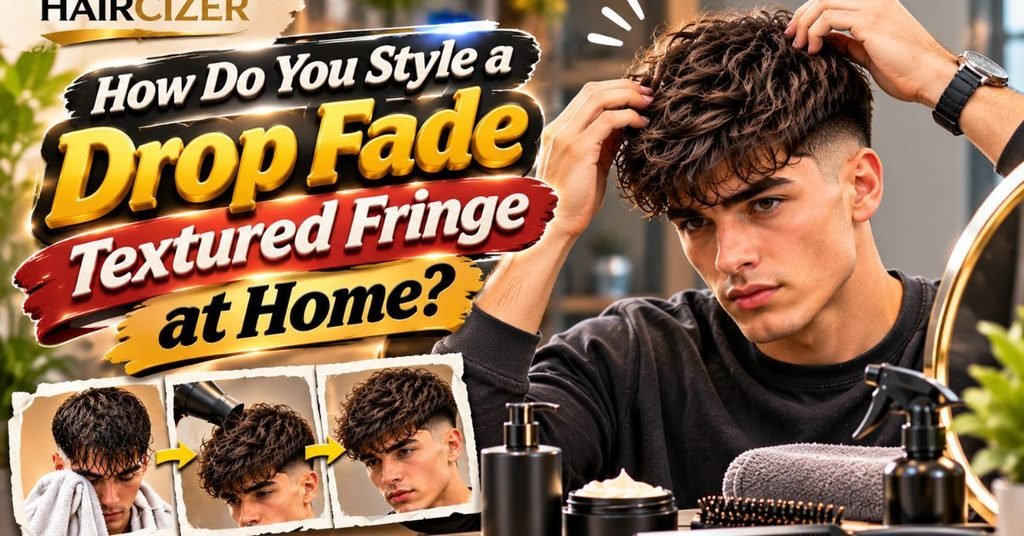
Good styling takes about five minutes. Start with towel-dried hair, since damp hair accepts products better than soaking wet hair.
Straight and wavy hair
Also Read:Shadow Fade Haircut Ideas: Low, Mid & High Fade Styles
- Dry the hair. Blow-dry on medium heat, directing the fringe forward and a little down. Use your fingers to rough it up as it dries.
- Add a pre-styler. A light sea salt spray or a bit of volumizing mousse gives grip and body.
- Warm the product. Rub a pea-sized amount of matte clay, paste or fibre between your palms until it is thin and even.
- Style the fringe. Run your fingers through the front, pulling pieces forward. Pinch the ends to create separation.
- Finish. A light mist of hairspray holds the shape without making it stiff.
Use matte products for a natural look. Shiny pomades make a textured fringe look flat and wet. For fine hair, use less product rather than more, since heavy wax weighs it down.
Curly and coily hair
- Start with clean, damp hair. Wash with a gentle shampoo and keep moisture in.
- Apply a leave-in conditioner or curl cream. Work it through from root to tip.
- Shape the fringe. Use your fingers or a soft brush to guide curls forward and make sure the ends sit where you want.
- Define. Twist small sections, or scrunch upward, to build curl definition.
- Dry. Air-dry or use a diffuser on low heat. Avoid touching the hair while it dries, which prevents frizz.
- Finish. Once dry, gently loosen the curls with your fingers. A bit of oil adds shine.
Curly hair needs moisture more than hold, so go for creams and gels over clay. Sleeping with a satin bonnet or pillowcase helps keep the shape fresh in the morning.
How often should you trim a drop fade textured fringe?

The fade is the high-maintenance part. The fringe is more relaxed. Here is a schedule you can follow:
| Part of the cut | Trim every | Why |
| Skin fade | 1 to 2 weeks | Skin shows regrowth quickly |
| High or mid fade | 2 to 3 weeks | The contrast softens fast |
| Low fade or guarded finish | 3 to 4 weeks | Stays neat for longer |
| Fringe and top | 6 to 8 weeks | Needs length to keep its shape |
| Neckline clean-up | Every 2 weeks | Keeps the back crisp between full cuts |
Many men book a fade tidy-up every two or three weeks and a full cut every second visit. That keeps the sides sharp without losing length on top. Ask your barber if they offer a quick “fade only” appointment, since it is usually shorter and cheaper.
At home, a trimmer with a guard can handle the neckline if you are careful. Do not try to fade the sides yourself unless you have experience, because mistakes show quickly and take weeks to grow out.
Common drop fade textured fringe problems and how to fix them

Even a great cut can go wrong. Most problems have simple fixes.
Fringe looks flat, heavy or “helmet-like”
A flat fringe usually has too much weight or too little texture. A helmet-like look appears when thick hair is cut into one even layer.
Try these fixes:
- Ask your barber to remove weight from the inside and point cut the ends.
- Use a light styling powder or sea salt spray at the roots to lift the fringe.
- Use less product and avoid heavy waxes that stick the hair together.
- Blow-dry the fringe in different directions before pushing it forward.
- Request a bit more length at the front and a shorter, lighter top so the shape is not bulky.
Fade is too high, back looks shelved or cowlick fights the cut
Fade too high. If the fade sits higher than you wanted, the head can look narrow and the top can feel too heavy. The fix is time or a blend. Let the sides grow for two weeks, then ask for a mid or low drop next visit. A good barber can also soften a harsh fade by blending the top into it.
Back looks shelved. A “shelf” appears when the fade stops abruptly and the longer hair sits above it like a step. It is a blending issue. Ask the barber to go back over the line with a lower guard or a trimmer to smooth the transition.
Cowlick fights the cut. A cowlick will push the fringe in a direction you did not choose. Work with it, not against it:
- Let the front stay a little longer so the weight pulls it down.
- Ask the barber to cut the fringe with the cowlick direction in mind, such as a side sweep instead of straight down.
- Blow-dry the area while it is wet to train it in the direction you want.
- Use a bit of paste at the root to hold it in place.
If a cut still goes wrong, do not wait too long to go back. Most barbers are happy to correct a blend within a few days, and clear photos help them see what you expected.
FAQs about the drop fade textured fringe
What is a drop fade?
A fade that curves down behind the ear.
What does a textured fringe mean?
A forward-styled fringe cut with broken, choppy ends.
Can I get a drop fade textured fringe with short hair?
Yes, if the top is at least two to three inches.
Does a drop fade suit curly hair?
Yes, it works well on curls and coils.
Is a drop fade the same as a taper fade?
No, the drop curves lower and fades shorter.
How long does a drop fade last?
About two to four weeks before it needs a tidy-up.
Which fade height is best?
A mid drop fade suits most heads.
What products should I use?
Matte clay, paste or sea salt spray for most hair types.
Is a drop fade textured fringe good for thin hair?
Yes, with extra length and light texturizing.
Can I wear it to work?
Yes, a low drop fade looks neat in most offices.
Conclusion
The drop fade textured fringe works because it balances two things men usually have to choose between. You get a sharp, clean outline and a soft, easy top. With the right height and the right length, it suits almost any hair type and face shape.
Once you know the six decisions to specify, ordering it is easy. Bring photos, be honest about your routine and book a quick tidy-up every few weeks. Do that, and your next haircut will look good from the first day to the last.
Leave a Reply